Happy Book Birthday: The Phantom Hour by Kat Shepherd

I am super excited to welcome our very own Kat Shepherd to the blog!!! Her new book, THE PHANTOM HOUR, releases today!! I recently had a chance to chat with Kat about her new book, a brand new mystery series and much more.

Q: You have a passion for animals, traveling and the outdoors, among many other interests. How have those passions found their way into your writing?
 
A: Like any author, I pull a lot from my own life to put into the stories I write. Lots of my characters are based on former students of mine or other people I know, but there’s always a little bit of me in there, too. In the newest Babysitting Nightmares book, THE PHANTOM HOUR, Clio shares my passions for travel and history and glimpses into the past. And in Book 2 we’ll meet Ethan, who has a really strong connection with animals. I train and foster dogs, so I really wanted to put a character in the series that reflects my own bond with animals.
 
Because I write suspense, I rarely put pets in my scary books, and there’s a really good reason for this. Anytime I see a pet in a scary movie or book, it immediately distracts me, because I get so worried that something is going to happen to it. (I blame Stephen King for this. Animals rarely fared well in his books!) So I intentionally avoid putting pets in, because I don’t want my readers worrying about them like I always did. But in PHANTOM HOUR I couldn’t resist bringing back my favorite dog, Wesley. He passed away in 2013, and I miss him every single day, so it was wonderful to get to write about him and see him come alive on the page. It was a little like getting to spend time with him again.
 
Q: Tell me more about microphilanthropy. Does it ever crop up in your books? How can readers get involved?
 
A: It’s important to me that my protagonists be kind and show compassion and generosity. Not because I’m trying to teach some big lesson to kids or anything, but because I have to spend a lot of time with my characters, and I don’t really like to be around people that aren’t kind or compassionate. Generosity and compassion are driving forces in my life; they absolutely give my life direction and purpose. That’s not to say that I am this supremely generous and compassionate person, but those are the qualities I am continuously striving toward. Failing to get there a lot, but always trying.
 
One of the biggest challenges of my life was that I have always wanted to be this great philanthropist, but I don’t really have any money. So in trying to figure out how to give meaningfully when the size of your wallet doesn’t match the size of your heart, I started pursuing a concept I call microphilanthropy. It’s based on the idea that you don’t need a lot of money to make positive, measurable change in your community. You just need people.
 
Basically, it’s crowdfunding, but rooted in the community. I find local organizations that need small, concrete projects funded: a science club at the library, blankets for the zoo’s chimpanzees, emergency rental assistance to keep a family from becoming homeless. Each project costs anywhere from $100 to $1200. Then I throw a party and invite the organizations to come a pitch their projects to my party guests. Then everyone at the party puts whatever money they can spare into jars we set up for each project. At the end of the night we count up and distribute the money, and the organizations go on to fund their projects. The average donation about $10 or $20 per person, but when you pool that money together, it makes these incredible things happen.It creates a really strong connection between people and their communities, and it feels really powerful to see that you made something amazing happen. The best part is seeing the excitement on my guests’ faces when they realize that they are the reason the library has a science club now, or a family didn’t lose their home. It wasn’t some rich person who did that. It was us.
 
I actually just wrote up a little how-to guide for folks who want to throw their own microphilanthropy party. They can email me at my website katshepherd.com, and I’m happy to send it over or help them strategize.
 
Q: What should readers expect from Book 2?
 
A: While Book 1 of Babysitting Nightmares took the girls into the Nightmare Realm, Book 2, THE PHANTOM HOUR, feels a little more grounded in this world. Clio gets a job babysitting for the Lee family, a new family who has moved into an abandoned old mansion at the edge of town. The Lees are lovely, and Clio is thrilled to get the chance to explore the old mansion… until she starts to realize it may be haunted. Luckily Clio has help from her friends and Aunt Kawanna, and she also gets some unexpected help from her new friend, Ethan, who has a few secrets of his own. Readers should expect a spooky ride of suspense, thrills and chills as Clio works to unlock the mansion’s mysteries before it’s too late.
 
Q: Are any of the thrills and chills from BABYSITTING NIGHTMARES based on real-life experiences?
 
A: Several generations of women in my family have had regular contact with ghosts. Ethan’s Great-Grandma Moina is based on family stories, but I made her backstory a lot more exciting than my own family’s. For my own great-grandmother ghosts very matter-of-fact and not at all mysterious; they were just around all the time. It was much more fun to make Moina a glamorous, professional medium who performed big, showy seances! To figure out how to do that I did a lot of research on the Spiritualist movement and the history of psychic mediums in the US. I even went to a seance in an old Victorian mansion! What I learned was that there were lots and lots of seances back then, but not a whole lot of ghosts. The magician Harry Houdini helped prove that most of the so-called mediums were faking it and using tricks and illusions to fool people into thinking that they were seeing and talking to ghosts. I’m not sure if I was disappointed or relieved to learn that!
 
Like the house in PHANTOM HOUR, my own house was vacant before we moved into it. We are only the third owners, and the last person who lived there was a woman who had lived there for 40 years. After she died her daughter held onto the house for another decade because she couldn’t bear to give up something her mother had loved so much. So we felt a little worried when we moved in that might find her ghost hanging around.
 
A few months after we moved in I went to bed early and my husband was still awake. For some reason he always keeps his dress shoes on after work, and it can be annoyingly loud when he walks around the house. I was awakened by his footsteps in the middle of the night, and I was super irritated that he hadn’t taken off his shoes. But then I rolled over and my husband was asleep next to me! I woke him up, and we both heard a man’s footsteps walking through the house. Our burglar alarm had been set and our dogs were sleeping peacefully, so we knew it couldn’t be an actual person. For some reason nothing about it felt scary at all, and we just went back to sleep. Our house was built by a judge, and we wonder if it was his otherworldly footsteps we heard. So we did end up having a ghostly encounter, just not with the ghost that we expected!
 
Q: What advice do you have for young fans who may be interested in writing their own stories?
 
A: I think one of the best things writers can do is to read a lot. Reading helps give you an instinct for story and language; you learn by seeing how other people do it. I also think it helps to read critically, with the eye of a writer. Read for enjoyment, but then take a minute to think about why you loved the story and what made it so good. Then think about those moments that weren’t so good. Did the story drag? Were there parts you got bored, or the action moved too fast? Reading like a writer is a big part of how I developed my own storytelling style and voice.
 
The other big part of writing your own stories is to WRITE THEM! Put them in a notebook, get a cool journal, or learn to type and store them electronically. If you’re excited to write but feel stuck for ideas, sometimes fanfic is a really fun place to start. Think of your favorite book and write a sequel, or choose a character from a book you love and put them on a new adventure. Create a mashup of your two favorite series. What would happen if the characters met? Spooky stories are also a great way to get started, because it automatically puts your writer’s imagination into overdrive! I teach a spooky story writing workshop, and I’m always happy to email aspiring writers the ideas and exercises I use to get started.
 
Once you get your stories down on paper, make sure you share them! Writers need readers. Ask your friends and families to read your work and share any moments where they got confused or needed more description, as well as those parts that made them laugh or jump out of their seats. Take that feedback and use it to make your story really sing. Writing a first draft is important, but revising is where the magic really happens. Most writers I know absolutely love to revise, because it lets us forget all the nitty-gritty and just focus on making the story the best that it can be.
 
north starQ: What can readers expect next from Kat Shepherd? I hear you may have a new mystery series coming later this year?
 

A: I have a new mystery series The Gemini Mysteries, that debuts on March 5 with THE NORTH STAR. I have been a huge mystery fan for as long as I can remember; so much so, in fact, that I have a mystery-themed tattoo sleeve that continues to evolve as I add more favorites to it. One of the things I loved most about mysteries is the interactive experience of reading one. You’re constantly taking in information, evaluating, predicting, and then re-evaluating based on a changing landscape of clues. So exciting as a reader, and such a great tool as a teacher! This series is especially fun because there is a picture at the end of every chapter with a clue hidden in it, and the reader gets to work alongside the detectives to find the clues that lead to the next step in the mystery.

 
It’s been fun for me, because Babysitting Nightmares and Gemini Mysteries are so different, but there is a lot of crossover between mystery and horror. I like to write fast-paced adventures with a little bit of humor and lots of suspense, and I think both series allow me to do that. I hope my readers will have as much fun reading them as I have writing them!

An Interview with Claribel Ortega, author of GHOST SQUAD

Hi everyone! Tania here. I’m happy for the opportunity to interview author Claribel Ortega whose debut middle grade novel, GHOST SQUAD, comes out this fall. We may have to wait a little while to get out hands on it, but check out this description in the meantime:

The hurricane-swept town of St. Augustine is the only home Lucely Luna has ever known. It’s the same home her father grew up in, and his parents before him. In fact, all of the deceased relatives in the Luna family now live as firefly spirits in the weeping willow tree in their backyard.

Shortly before Halloween, a mysterious storm appears on the radar heading towards St. Augustine, causing Lucely’s firefly spirits to lose their connection to this world. In an effort to save them, Lucely finds a spell to bring them back to life, but accidentally brings more spirits to the town than she’d planned. Ghosts start showing up all around town, some more dangerous than others, wreaking havoc.

Lucely will have to band together with her best friend and occult buff, Syd, along with Syd’s witch grandmother, Babette, and her tubby tabby, Chunk, to fight the haunting head on, save the town, and save her firefly spirits all before the full moon culminates on Halloween. 

Sounds great, doesn’t it? I can hardly wait! Now, let’s get on with the Q+A.

TANIA: I’m very excited to read GHOST SQUAD which sounds very spooky, indeed! But, reading the description, I’m also intrigued by its family themes and elements of magical realism. Can you talk a little bit about how your own background has influenced your story?

CLARIBEL: I’m excited you’re excited about Ghost Squad! The story is very close to my heart and directly influenced by both my childhood and my experience with loss. As a kid, I used to catch fireflies in glass jars with my late, older brother. My family is from The Dominican Republic and we have mythology that says fireflies are the souls of our loved ones who have passed on, and that those fireflies are watching over us. I loved the idea of still having my brother around, looking out for me and that led to Lucely Luna’s story!

TANIA: As an author, why do you think spooky stories are important for young readers? Do you think it’s possible to get too dark or scary when it comes to writing Middle Grade fiction?

CLARIBEL: I think it is definitely possible to get too dark (in fact there was one scene I had to cut from Ghost Squad because it was too scary!) but it also varies on the reader. I was reading Stephen King at a pretty young age, he was my transition into adult books after Ghost Bumps. Did I have nightmares? Yes. Do I recommend it? Also yes.

TANIA: What are some of your favorite spooky books or movies and why?

CLARIBEL: So, I am a giant chicken with spooky movies and will read the Wikipedia plot before I watch to make sure I can handle it lol. I prefer scary movies that don’t rely on jump scares and have a frightening twist at the end (Like THE SKELETON KEY or THE SIXTH SENSE) but normally I lean into the not actually scary but sort of campy/fun spooky movies like CLUE or GHOSTBUSTERS. I can handle a lot more when it comes to books, and as I said I love Stephen King and anything true crime or serial killer related because it’s fascinating!

TANIA: Have you personally ever seen a ghost or experienced the supernatural?

CLARIBEL: I have. Once at my old house, I was constantly seeing a little girl running through the hall out of the corner of my eye. I never said anything until one day I was standing by the stairs next to my older sister and saw her. We both flinched at the same time then looked at one another, eyes wide like “You saw her too?” It was creepy, but I wasn’t necessarily scared. I don’t think she meant us any harm.

TANIA: What advice would you give a young, aspiring writer? Is there something you wish someone had told you when you were starting out?

CLARIBEL: Your career might not unfold how you expect it to but that doesn’t make it any less worth celebrating. Things take a long time in publishing, and it’s okay if things don’t pan out the way you planned, the goal is longevity not instant success. Focus on the things you can control, like your writing, be willing to fight for yourself when you need to, and remember to celebrate the good not just focus on the bad.

***

And there you have it! We’ll be keeping an eye out for Claribel’s book and cover reveal. In the meantime, you can follow her on Twitter or Instragram. Also visit her website to sign up for her newsletter.

DEFEATING YOUR FEAR OF WRITING

black and white blur close up fingers

“Fear is a steal trap,” Gran advises Evangeline, the heroine of my debut middle grade novel. EVANGELINE OF THE BAYOU is the story of twelve-year-old Evangeline Clement, a haunt huntress apprentice studying the ways of folk magic and honing her monster-hunting skills. As soon as her animal familiar makes itself known, the only thing left to do is prove to the council she has heart. Then she will finally be declared a true haunt huntress. Of course, things do not go as planned for Evangeline. And when she and her grandmother are called to New Orleans to resolve an unusual case, she must summon her courage to defeat a powerful evil that’s been after her family for generations.

Gran goes on to warn Evangeline, “Fear keeps you from moving forward. It binds up your courage as well as your smarts.” These wise words of Gran’s hold true for nearly any situation we encounter, whether it be hunting monsters or writing essays.

As the leader of a local writers group for the past dozen years, and having been a member of numerous critique groups, I’ve learned that one thing we creatives all have in common is fear. And we have a lot of them, like: showing our writing to family and friends, getting our work critiqued by other writers, not knowing how to begin our stories, not knowing how to end our stories, or not being able to come up with any new ideas. But one of the most common fears I’ve seen is that of simply getting started, rallying the courage to just jump in and begin the writing of that novel, memoir, or short story. I call it “freezing on the high-dive”. Taking that initial leap can be scary, but it doesn’t have to be.

After discussing this topic with numerous fellow writers over numerous coffees and teas, I’ve come to suspect this particular fear stems from the mistaken belief that we have to get our words right the first time, that somehow a perfect stream of brilliance must flow straight from our head and onto the blank sheet of paper. This unrealistic expectation can lead to a lot of frustration and writing resistance. Fortunately, there are a few easy techniques writers of any age and any writing level can incorporate to defeat their fear of writing and get their words moving forward. These simple tips can be applied to everything from the writing of novels and essays, to the writing of thank you notes.

The first step is to think of the writing process as one that uses two distinct parts of your brain: the creative side and the editorial side. Going into a project while trying to use them simultaneously is when many of us run into trouble. The two parts do not play, or work, well together.

Once you’ve accepted the fact that you’ve essentially just carved your brain into two halves, the next step is to hush that editorial side. Reassure it that it will have its turn to make corrections and clean things up later, but for now it’s Creative’s turn to play. Allow your imagination to run wild and free. Let go of rules and logic. There are no right or wrong ideas in this phase of your project. Don’t worry about choosing the perfect word, and don’t worry about things like spelling and punctuation. That’s Editor’s job for later on.

If you’re still having trouble coming up with ideas, here’s another helpful tip: just start writing. Write anything, even if it’s simply the words, “I don’t know what to write.” There’s something almost magical about the act of putting pen to paper, or fingers to keyboard, that gets the creative tap flowing. Taking away all those expectations of perfection will conquer that fear of not being able to think of anything to write.

Now that you’ve got some great ideas and images, and maybe even some really cool lines of dialogue, let your creative side take a rest. This is the time to set your internal editor free. Allow it to get to work picking and choosing what elements to use, what order to put them in, and making sure the grammar, spelling, and punctuation are all up to snuff.

This is the technique I used while writing EVANGELINE OF THE BAYOU, and I’m using it now as I work on the sequel. Keeping the creative half of my mind separated from the editorial half has helped me defeat my fear of just diving into the writing. It’s helped me overcome my worry that my writing is too sloppy, nonsensical, and filled with mistakes. I know that by setting my creative side free to do what it does best, it’ll provide me with fun, fresh, and unexpected ideas. Sometimes it delivers more ideas than I can use, or ideas that are in need of further research and tweaking, but that’s okay, because I know I’ll soon be unleashing my editorial side to make my words all shiny and clean.

Photo by rawpixel.com on Pexels.com

Right In the Funny Bone: Why Spooky and Funny Are A Natural Fit

If you haven’t done it yourself, you’ve seen someone else do it. They reach a scary moment in a book, or a jump scare in a movie, or even stumble upon a prankster who jumps out at them from behind something– and instead of screaming, they burst out laughing.

boy in black v neck shirt with looking straight to the camera with a shocking face expression

What is it that makes us laugh when all signs point to “AHHHHHH?” Scientists have a handful of theories:

Some say it’s a sort of peace offering– an instinctive reaction to confrontation. Laughing shows we’re not looking for a fight, so whatever’s coming at us will hopefully back down and go away.

Others suggest that laughing is a way to manage our fear. When we laugh in the face of danger, we’re trying to convince ourselves things are less dire than they seem.

But my favorite explanation (and the one that makes the most sense in connection with scary stories) is that laughing when we’re afraid or crying when we’re happy actually balances us out emotionally.

Speaking as a reader, one of the things I love most about middle grade is the way our main characters are centered in their family and community– I draw deep satisfaction from the inherent wholeness and balance of middle grade worlds. As a writer and lifelong smart aleck, shared humor is one of my favorite things to write; to me, it’s a sign of a close, happy community. I can’t imagine penning a family or town where people don’t joke, tease, and mildly snark.

child in blue and yellow jersey shirt with the two other kids
Photo by Snapwire on Pexels.com

As you read this, you might be thinking, “Wait a minute. It’s conflict, not happiness, that drives a story. Especially a spooky story!” You’re right, of course. But it’s also important to remind the reader what your characters are fighting for. Shared humor reinforces a sense of belonging and reminds us what we like about certain characters. Conversely, humor meant to embarrass or bully someone hardens our hearts against a villain.

Wisecracks are also the perfect opportunity to illuminate individual personalities and relationships between characters in a “show, don’t tell” way. For example, when a group of kids has to cross dangerous territory, a competitive best friend or sibling might say, “Hey, your shoe’s untied!” in order to get a head start. The competition between the characters gives them the courage to face the peril.

On the other hand, a nervous friend who’d rather be at home under the covers is more likely to resort to gallows humor, like, “It’s my night to feed the dog. He’s going to be seriously crabby when I die and his bowl is empty.” How other characters respond to this joke will be revealing. Are they impatient? Reassuring? Or do they toss another joke right back?

If you love writing stories with lots of scares, laughter can also provide some much-needed contrast. I adore a runaway horror story as much as the next spooky author, but like true joy, intense fear is hard to sustain. Worse, fear actually gets exhausting after a while. Raise your hand if you write to exhaust your readers. No? Then consider providing moments of levity to give them a break.

This is all well and lovely and I mean every word, but don’t be fooled– I’m no altruist. There are lots of upbeat reasons to put some banter in your book, but you can also use laughs to trap the unwary. I love to use humor to lull my readers into a false sense of security. Then, when it’s time for the next creepy moment, I’ve got them exactly where I want them! So, if you haven’t tried mixing jump scares with jokes, I highly recommend it. You don’t have to be a serious person to deliver some serious scares!

portrait of happy girls sitting


About the Author
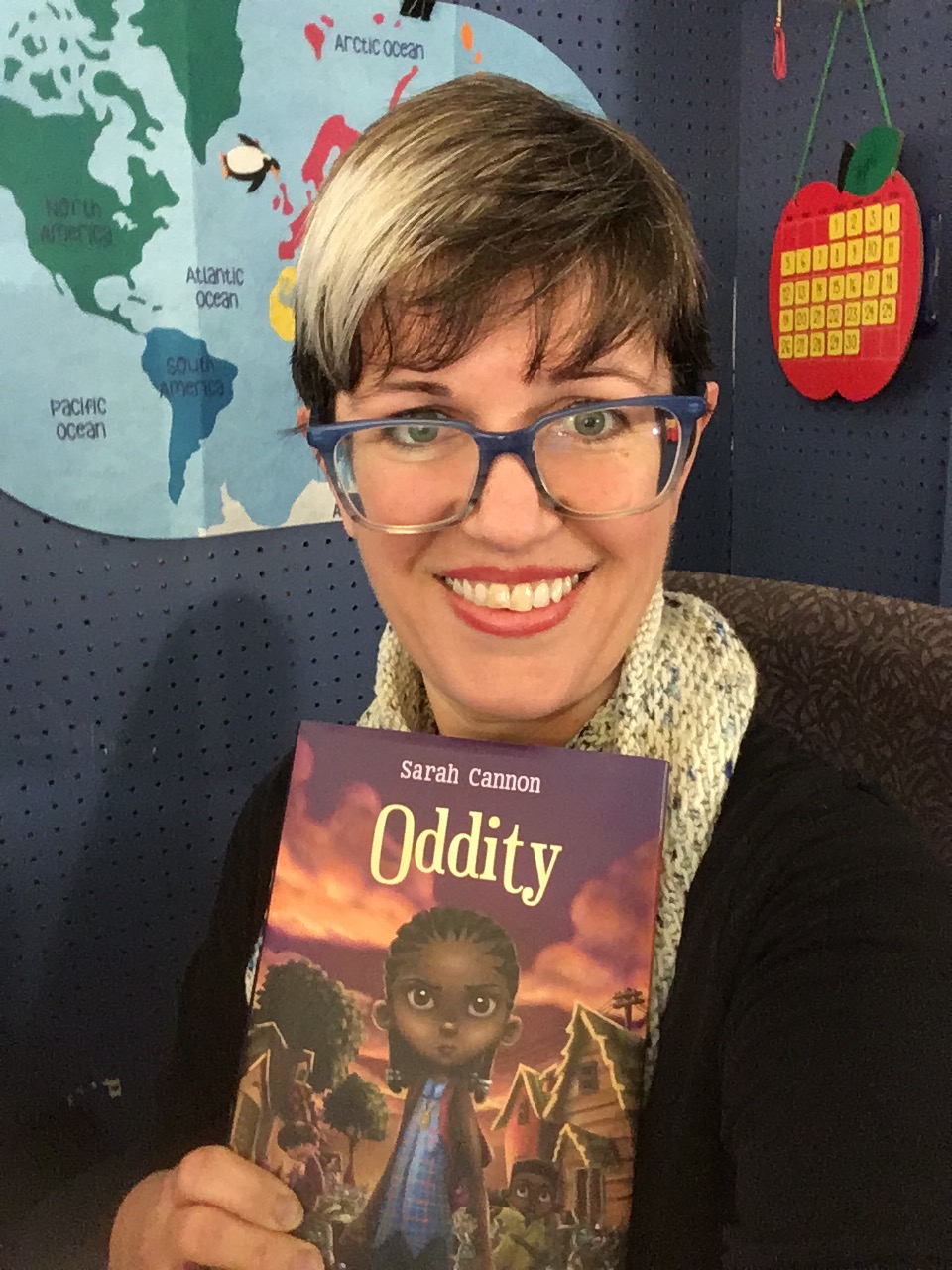
47273607_257902428237874_7097488376386813952_n


Sarah Cannon, author of Oddity, has lived all over the U.S., but right now she calls Indiana home. She has a husband, three kids and a misguided dog. Sarah holds a B.S. in Education. She’s a nerdy knitting gardener who drinks a lot of coffee, and eats a lot of raspberries.

She is probably human.

Find her on Website | Twitter | Facebook